Industrial manufacturing processes demand efficient methods to convert liquid materials into dry powders while preserving their essential properties. Understanding the spray dryer working principle becomes crucial for industries ranging from pharmaceuticals to food processing. This comprehensive guide reveals how spray dryers transform liquid feeds into high-quality powdered products through a sophisticated yet elegant process that has revolutionized modern manufacturing.
The spray dryer working principle centers on the rapid evaporation of moisture from atomized liquid droplets in a controlled hot air environment. This technology enables manufacturers to produce consistent, free-flowing powders with precise particle size distribution and minimal thermal degradation. Whether you’re processing milk powder, pharmaceutical compounds, or chemical solutions, mastering this principle determines your product quality and operational efficiency.
Table of Contents
What is a Spray Dryer and How Does It Work?
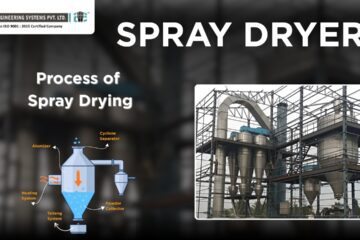
A spray dryer is industrial equipment that converts liquid or paste materials into dry powder form through a continuous process. The fundamental spray dryer working principle involves four critical stages: atomization, mixing, drying, and separation.
The process begins when liquid feed enters the drying chamber through an atomizer system. Hot air simultaneously enters the chamber, creating optimal conditions for moisture evaporation. The atomizer breaks down the liquid into fine droplets, dramatically increasing the surface area exposed to hot air. This expanded surface area accelerates the drying process while maintaining gentle treatment of heat-sensitive materials.
The spray dryer working principle ensures rapid moisture removal occurs within seconds rather than the hours required by traditional drying methods. This speed prevents thermal degradation while producing powders with excellent flow properties and consistent particle characteristics.
The Four Essential Components of Spray Dryer Working Principle
1. Feed System and Liquid Preparation
The spray dryer working principle starts with proper feed preparation. The liquid feed must maintain consistent concentration, temperature, and viscosity to ensure uniform atomization. Feed pumps deliver the liquid at controlled rates to the atomizer system.
Feed preparation significantly impacts the final product quality. Viscous liquids require different atomization techniques compared to thin solutions. The feed system must handle various liquid types while maintaining steady flow rates essential for consistent powder production.
2. Atomization Process
Atomization represents the heart of the spray dryer working principle. This process converts liquid feed into fine droplets ranging from 10 to 200 microns in diameter. Three primary atomization methods exist:
Pressure Nozzle Atomization: High-pressure pumps force liquid through specially designed nozzles, creating fine droplets through pressure release. This method works excellently for low-viscosity liquids and produces uniform particle sizes.
Rotary Atomization: A high-speed rotating disc or wheel throws liquid outward through centrifugal force, forming droplets. This technique handles higher viscosity liquids and provides excellent control over particle size distribution.
Two-Fluid Atomization: Compressed air or steam contacts the liquid feed, creating droplets through momentum transfer. This method suits heat-sensitive materials and produces very fine particles.
The atomization quality directly affects the spray dryer working principle efficiency. Proper droplet size ensures complete moisture removal while maintaining product integrity.
3. Hot Air Generation and Distribution
The spray dryer working principle relies on precisely controlled hot air to remove moisture from atomized droplets. Air heating systems generate hot air at temperatures typically ranging from 150°C to 300°C, depending on the product requirements.
Hot air distribution systems ensure uniform temperature and airflow throughout the drying chamber. Proper air distribution prevents hot spots that could damage heat-sensitive materials while ensuring complete moisture removal from all droplets.
The air flow pattern significantly impacts drying efficiency. Co-current flow, where hot air and droplets move in the same direction, provides gentle drying suitable for heat-sensitive products. Counter-current flow offers higher thermal efficiency but requires careful temperature control.
4. Product Separation and Collection
The final stage of the spray dryer working principle involves separating dried powder from the air stream. Cyclone separators use centrifugal force to separate particles based on size and density. Larger particles collect in the cyclone bottom while fine particles may require additional separation.
Bag filters or cartridge filters capture fine particles that escape primary separation. This two-stage separation ensures maximum product recovery while maintaining powder quality. The separated powder then undergoes final processing or packaging.
Types of Spray Dryers and Their Working Principles
Co-Current Spray Dryers
Co-current spray dryers operate with hot air and atomized droplets flowing in the same direction. This configuration provides gentle drying conditions ideal for heat-sensitive materials like pharmaceuticals and food products.
The co-current spray dryer working principle ensures droplets encounter the highest temperatures when moisture content is maximum. As drying progresses and moisture decreases, droplets experience lower temperatures, preventing thermal damage to the final product.
Counter-Current Spray Dryers
Counter-current spray dryers introduce hot air opposite to the droplet flow direction. This arrangement maximizes heat transfer efficiency but requires careful temperature control to prevent product degradation.
The counter-current spray dryer working principle achieves higher thermal efficiency compared to co-current systems. However, this configuration suits products with higher temperature tolerance due to the intense heat exposure near the chamber outlet.
Mixed-Flow Spray Dryers
Mixed-flow spray dryers combine elements of both co-current and counter-current designs. Hot air enters from multiple points, creating complex flow patterns that optimize drying efficiency while maintaining product quality.
This spray dryer working principle offers flexibility in handling various product types and processing conditions. The mixed-flow design allows operators to adjust air flow patterns based on specific product requirements.
Key Factors Affecting Spray Dryer Working Principle
Temperature Control
Temperature control remains critical to the spray dryer working principle success. Inlet air temperature determines the driving force for moisture evaporation, while outlet temperature indicates drying completion.
Excessive temperatures can cause product degradation, scorching, or unwanted chemical reactions. Insufficient temperatures result in incomplete drying, leading to product stability issues and storage problems.
Airflow Rate and Pattern
Airflow rate affects residence time and heat transfer efficiency. Higher airflow rates provide more heat for drying but reduce particle residence time in the chamber. Lower airflow rates increase residence time but may cause insufficient heat transfer.
The spray dryer working principle requires balanced airflow to achieve optimal drying without product degradation. Proper airflow pattern ensures uniform drying throughout the chamber volume.
Feed Rate and Concentration
Feed rate directly impacts the spray dryer working principle efficiency. Higher feed rates increase production capacity but may overwhelm the drying system, leading to incomplete moisture removal.
Feed concentration affects droplet size and drying time. Higher concentrations require more energy for moisture removal but produce denser particles. Lower concentrations dry faster but may result in hollow particles.
Atomization Quality
Atomization quality determines particle size distribution and drying uniformity. Consistent atomization ensures predictable product characteristics and optimal drying efficiency.
Poor atomization creates uneven droplet sizes, leading to inconsistent drying. Large droplets may not dry completely, while extremely small droplets might over-dry or create dust problems.
Applications of Spray Dryer Working Principle
Food Industry Applications
The food industry extensively utilizes the spray dryer working principle for producing milk powder, coffee powder, fruit juices, and nutritional supplements. This technology preserves nutritional value while extending shelf life.
Spray drying enables the production of instant food products with excellent reconstitution properties. The gentle drying process maintains flavor compounds and nutritional integrity essential for food applications.
Pharmaceutical Manufacturing
Pharmaceutical companies rely on the spray dryer working principle to produce drug powders, excipients, and pharmaceutical intermediates. The controlled drying environment ensures consistent drug potency and stability.
The spray dryer working principle allows pharmaceutical manufacturers to create particles with specific size distributions and surface properties crucial for drug delivery and bioavailability.
Chemical Industry Applications
The chemical industry uses spray drying for producing catalysts, pigments, ceramics, and specialty chemicals. The precise control offered by the spray dryer working principle ensures consistent product quality.
Chemical applications often require specific particle characteristics such as high surface area, controlled porosity, or particular crystal structures. The spray dryer working principle enables manufacturers to achieve these requirements.
Agricultural Products
Agricultural applications include producing pesticide formulations, fertilizers, and animal feed supplements. The spray dryer working principle transforms liquid formulations into stable, easy-to-handle powders.
This technology enables the encapsulation of active ingredients, providing controlled release properties and improved storage stability for agricultural products.
Advantages of Spray Dryer Working Principle
Rapid Drying Process
The spray dryer working principle achieves complete moisture removal within seconds, significantly faster than traditional drying methods. This rapid processing minimizes thermal exposure time, preserving heat-sensitive compounds.
Quick drying prevents microbial growth and chemical degradation that might occur during extended drying periods. The speed advantage makes spray drying ideal for large-scale production requirements.
Precise Particle Control
The spray dryer working principle provides excellent control over particle size, shape, and density. Operators can adjust atomization parameters to achieve specific particle characteristics required for different applications.
Consistent particle properties ensure predictable product performance in downstream processes. This control capability distinguishes spray drying from other powder production methods.
Continuous Operation
Spray dryers operate continuously, enabling high production rates and efficient manufacturing processes. The continuous nature of the spray dryer working principle reduces labor costs and increases operational efficiency.
Continuous operation also provides better process control compared to batch systems, resulting in more consistent product quality and reduced production variations.
Versatile Product Handling
The spray dryer working principle handles various liquid types, from thin solutions to thick pastes. This versatility makes spray drying suitable for diverse industries and product requirements.
The technology accommodates different feed characteristics without major equipment modifications, providing flexibility for manufacturers producing multiple products.
Challenges and Limitations
Energy Consumption
The spray dryer working principle requires significant energy input for air heating and atomization. Energy costs can become substantial, especially for large-scale operations processing high-moisture feeds.
Efficient heat recovery systems and optimized operating parameters help reduce energy consumption. However, energy requirements remain a primary consideration in spray dryer design and operation.
Fine Particle Handling
The spray dryer working principle often produces fine particles that can be difficult to handle and separate. Fine particles may require specialized collection systems and create dust-related safety concerns.
Proper dust collection and handling systems are essential for safe and efficient operation. This requirement adds complexity and cost to spray dryer installations.
Equipment Investment
Spray dryer systems require substantial capital investment, including the main equipment, auxiliary systems, and installation costs. The initial investment can be significant for smaller manufacturers.
However, the long-term benefits of improved product quality, operational efficiency, and production capacity often justify the investment in spray drying technology.
Optimizing Spray Dryer Working Principle Performance
Process Parameter Optimization
Optimizing the spray dryer working principle requires careful adjustment of multiple parameters. Temperature profiles, airflow rates, feed rates, and atomization settings must work together harmoniously.
Regular monitoring and adjustment of these parameters ensure consistent product quality and operational efficiency. Process optimization often requires extensive testing and experience with specific products.
Maintenance and Cleaning Procedures
Proper maintenance ensures reliable operation and extends equipment life. Regular cleaning prevents product buildup that could affect the spray dryer working principle efficiency.
Scheduled maintenance includes atomizer inspection, air filter replacement, and heat exchanger cleaning. Preventive maintenance reduces downtime and maintains optimal performance.
Quality Control Measures
Implementing robust quality control measures ensures consistent product quality. Regular testing of particle size, moisture content, and other critical parameters validates the spray dryer working principle effectiveness.
Quality control systems should include real-time monitoring capabilities and automated adjustments to maintain optimal operating conditions.
Frequently Asked Questions About Spray Dryer Working Principle
How does atomization affect the spray dryer working principle?
Atomization directly impacts drying efficiency by controlling droplet size and surface area. Smaller droplets dry faster but require more energy for atomization. Larger droplets may not dry completely within the available residence time. Optimal atomization balances these factors to achieve efficient drying while maintaining product quality.
What determines the residence time in spray dryer working principle?
Residence time depends on chamber size, airflow rate, and particle settling velocity. Longer residence times allow complete moisture removal but increase equipment size and cost. Shorter residence times reduce equipment size but may result in incomplete drying. The spray dryer working principle requires sufficient residence time for complete moisture removal without product degradation.
How does feed concentration affect spray dryer working principle efficiency?
Feed concentration significantly impacts drying efficiency and energy consumption. Higher concentrations require more energy for moisture removal but produce higher yields per unit of feed processed. Lower concentrations dry more easily but require processing larger volumes. Optimal feed concentration balances energy efficiency with production capacity requirements.
What safety considerations apply to spray dryer working principle?
Safety considerations include dust explosion prevention, hot surface protection, and proper ventilation. The spray dryer’s working principle creates fine particles that can form explosive mixtures with air. Proper grounding, explosion venting, and inert gas systems may be required. Hot surfaces require appropriate insulation and warning systems to prevent burns.
How does the spray dryer working principle compare to other drying methods?
The spray dryer working principle offers advantages in speed, particle control, and continuous operation compared to tray drying, fluid bed drying, or freeze drying. However, it requires higher capital investment and energy consumption. The choice depends on product requirements, production scale, and economic considerations.
Conclusion
The spray dryer working principle represents a sophisticated yet elegant solution for converting liquid materials into high-quality powders. This technology combines precise atomization, controlled thermal treatment, and efficient separation to produce consistent products across diverse industries.
Understanding the spray dryer working principle enables manufacturers to optimize their processes, improve product quality, and increase operational efficiency. The four essential components – feed system, atomization, hot air generation, and product separation – work together to create a versatile and reliable drying system.
Success with spray drying requires careful attention to process parameters, proper equipment maintenance, and continuous optimization. The spray dryer working principle offers significant advantages in terms of speed, product control, and continuous operation, making it an essential technology for modern manufacturing.
As industries continue to demand higher quality standards and more efficient processes, the spray dryer working principle will remain a cornerstone technology for powder production. Manufacturers who master this principle will maintain competitive advantages in their respective markets while delivering superior products to their customers.
For over three decades, Acmefil Engineering Systems Pvt. Ltd. has been at the forefront of spray drying technology innovation. As an ISO 9001:2015 certified company established in 1992, Acmefil designs and manufactures advanced spray dryers that embody the latest developments in drying technology. Their spray dryers feature precision-engineered atomization systems, energy-efficient heating mechanisms, and superior product separation capabilities, delivering exceptional powder quality while minimizing operational costs. With over 800 successful installations across India, Acmefil is a leading spray dryer manufacturer that provides comprehensive turnkey solutions that include design, manufacturing, installation, and after-sales support, ensuring optimal performance and reliability for diverse industrial applications from pharmaceuticals to food processing.